You are currently viewing documentation for CompuTec ProcessForce 3.0, which is a plugin installed and managed through CompuTec AppEngine 3.0, built on .NET 8. If you are working with older environments, you may need the documentation for CompuTec ProcessForce 2.0: https://learn.computec.one/docs/processforce/2.0/.
Please note that CompuTec ProcessForce 2.0 will be supported only until December 31, 2026. After this date, the product will no longer receive regular support or maintenance updates. Read more
CompuTec AppEngine 3.0 introduces a new architecture, and all CompuTec components, including the CompuTec ProcessForce 3.0 plugin, must be updated together to ensure full compatibility.
Before starting your installation or upgrade process, we strongly recommend reviewing the CompuTec AppEngine 3.0 and CompuTec ProcessForce 3.0 documentation.
CompuTec ProcessForce Architecture
CompuTec ProcessForce extends SAP Business One with advanced manufacturing, quality control, traceability, costing, and planning functionality.
The solution is built on Microsoft .NET technology and integrates directly with SAP Business One, allowing users to manage manufacturing processes without leaving the SAP environment.
CompuTec ProcessForce supports both Microsoft SQL Server and SAP HANA deployments.
Architecture overview
CompuTec ProcessForce consists of several components that work together to provide business functionality, user interfaces, data management, and reporting capabilities.
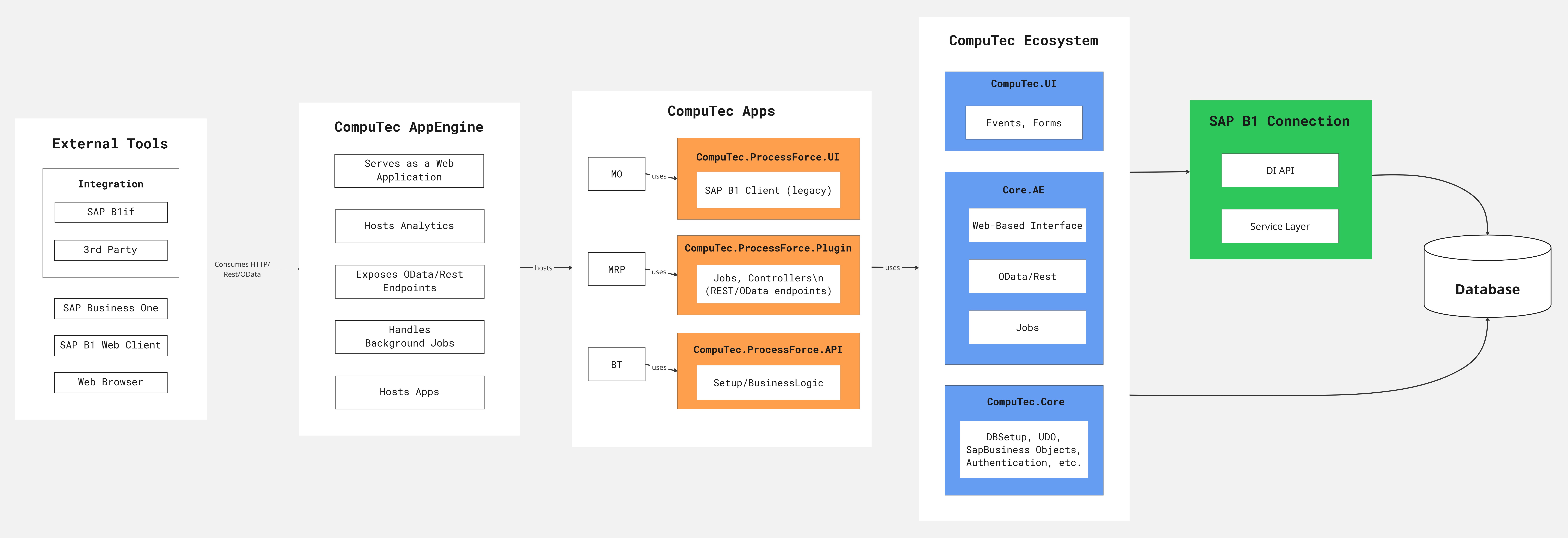
The solution operates via an executable process ProcessForce.exe, and integrates with SAP Business One through standard SAP APIs and database structures while adding manufacturing-specific functionality and data.
Key Architectural Components
CompuTec ProcessForce API
The CompuTec ProcessForce API is responsible for processing business logic and communicating with SAP Business One. It handles manufacturing transactions, validations, calculations, and data processing required by CompuTec ProcessForce functionality.
The API communicates with SAP Business One using the SAP Business One Data Interface (DI) API and optimized database access with Direct Access Mode using ADO.NET mechanisms.
User interface (UI)
CompuTec ProcessForce provides user interfaces integrated directly into SAP Business One.
Most functionality uses the standard SAP Business One user interface framework, ensuring a consistent user experience.
Some features use SAPUI5 technology to provide more advanced and interactive screens. Examples include:
- Batch Traceability 360
- MRP 2.5
- Serialization
- Mass BOM Change
Data storage
CompuTec ProcessForce stores its configuration and manufacturing data within the SAP Business One database.
The solution uses standard SAP Business One extensibility objects, including:
- User-Defined Tables (UDTs)
- User-Defined Fields (UDFs)
- User-Defined Objects (UDOs)
This approach ensures that manufacturing data remains fully integrated with the SAP Business One data model.
Reporting and Analytics
CompuTec ProcessForce includes reporting and analytics capabilities for manufacturing, quality control, costing, and traceability processes.
Depending on the database platform, different technologies are used to optimize performance:
SAP HANA
SAP HANA deployments use:
- Calculation Views
- CompuTec Semantic Model
These technologies provide optimized analytical performance and advanced reporting capabilities.
Microsoft SQL Server
Microsoft SQL Server deployments use:
- Views
- Functions
- Stored Procedures
These objects support reporting and data retrieval for operational and analytical processes.
On both platforms, users can retrieve data using User Queries and generate reports with Crystal Reports.
Database platform support
CompuTec ProcessForce supports both:
- SAP HANA
- Microsoft SQL Server
Most features are available on both platforms.
The primary difference is the availability of the CompuTec Semantic Model, which is supported only on SAP HANA and provides enhanced analytical capabilities.
Benefits of the CompuTec ProcessForce 3.0 architecture
The CompuTec ProcessForce architecture is designed to:
- Extend SAP Business One with advanced manufacturing functionality
- Maintain tight integration with SAP Business One data and processes
- Support both SAP HANA and Microsoft SQL Server environments
- Provide scalable reporting and analytics capabilities
- Enable future enhancements without modifying SAP Business One core functionality
Additional information
-
For installation instructions, see the CompuTec ProcessForce installation documentation.
-
For technical integration details, see the developer documentation.